
15 Classic Science Fiction Novels That Imagined the Future
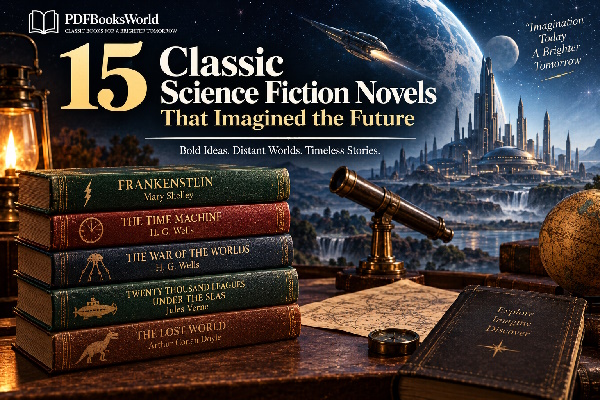
Famous Classic Science Fiction Books to Explore
The following 15 novels represent important works of science fiction and imaginative literature. Each book offers a unique story involving scientific ideas, extraordinary discoveries, exploration, or the future of human civilization.-
Frankenstein – Mary Shelley
A scientist creates life through an unusual experiment, but his creation leads to tragedy and isolation. The novel explores scientific ambition, responsibility, and the consequences of unchecked experimentation.
-
The Time Machine – H. G. Wells
A scientist travels far into the future using a time machine and discovers a dramatically changed human society. The story examines evolution, social inequality, and the possible direction of civilization.
-
The War of the Worlds – H. G. Wells
Martians invade Earth with advanced technology, forcing humanity to struggle for survival. The novel explores fear, technological superiority, and human vulnerability.
-
Twenty Thousand Leagues Under the Seas – Jules Verne
Professor Aronnax journeys beneath the oceans aboard Captain Nemo’s extraordinary submarine, the Nautilus. The book combines underwater exploration, scientific invention, and thrilling adventure.
-
From the Earth to the Moon – Jules Verne
A group of enthusiasts plans an ambitious journey to the Moon using a powerful projectile. The novel reflects nineteenth-century fascination with engineering, astronomy, and space travel.
-
Journey to the Centre of the Earth – Jules Verne
A professor and his companions enter a volcanic passage and discover an extraordinary world beneath the Earth’s surface. The story combines geological speculation, danger, and exploration.
-
The Invisible Man – H. G. Wells
A scientist discovers a method of making himself invisible, but his invention gradually leads him toward isolation and dangerous behavior. The novel considers power, morality, and scientific responsibility.
-
The Island of Doctor Moreau – H. G. Wells
A shipwreck survivor discovers an isolated island where a scientist conducts disturbing experiments on animals. The story raises questions about cruelty, ethics, and the boundaries of scientific research.
-
The Lost World – Arthur Conan Doyle
An expedition discovers a remote plateau inhabited by prehistoric creatures. The novel combines exploration, scientific curiosity, danger, and adventure in an unfamiliar environment.
-
The First Men in the Moon – H. G. Wells
Two men travel to the Moon using a substance that blocks gravity and encounter an unusual lunar civilization. The book explores space exploration, invention, and contact with alien life.
-
Looking Backward – Edward Bellamy
A man awakens in a future society organized around radically different economic and social systems. The novel uses speculative fiction to examine work, wealth, technology, and social organization.
-
The Last Man – Mary Shelley
Set in a future affected by a devastating plague, the novel follows individuals facing loss and the collapse of society. It explores loneliness, friendship, survival, and humanity’s uncertain future.
-
Around the World in Eighty Days – Jules Verne
Phileas Fogg attempts to travel around the world within eighty days, relying on the transportation systems of the modern age. The story celebrates travel, invention, determination, and adventure.
-
Flatland – Edwin Abbott Abbott
A two-dimensional world is used to introduce readers to unusual mathematical ideas and different dimensions. The novel also offers a thoughtful examination of social hierarchy and restricted thinking.
-
The Strange Case of Dr. Jekyll and Mr. Hyde – Robert Louis Stevenson
A scientist develops a formula that separates opposing sides of his personality. This famous story explores human nature, experimentation, morality, and the dangers of uncontrolled ambition.